Guinea-Bissau has entered a new political chapter after a dramatic military takeover that removed President Umaro Sissoco Embaló from power. A top army general has now been sworn in as the transitional president, marking another major shift in Guinea-Bissau’s long history of political instability.
A day after military officers announced they had seized power, General Horta Inta-A was sworn in as the transitional president of Guinea-Bissau. The ceremony took place at the military headquarters in Bissau, where he also took leadership of the High Military Command.
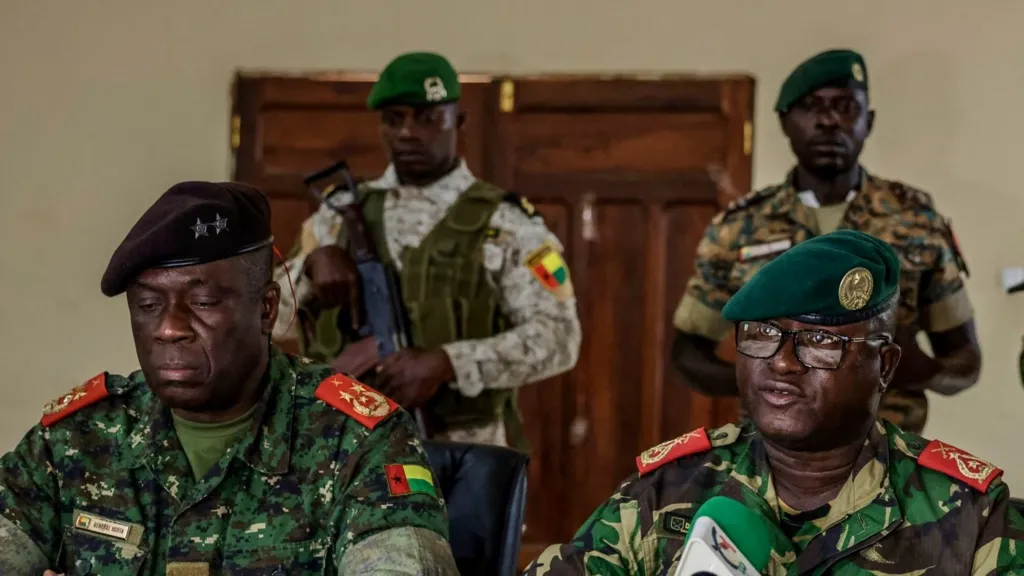
Dozens of heavily armed soldiers were stationed around the venue as the general declared he would lead the new transitional government for one year. The military said the change was necessary to “restore order” in Guinea-Bissau after the disputed presidential election.
Background to the Coup
Tensions rose in Guinea-Bissau after both President Umaro Sissoco Embaló and opposition candidate Fernando Dias claimed victory in a tightly contested election. Before the provisional results could be announced, gunfire erupted near key government buildings, including the presidential palace and the National Electoral Commission.
Shortly afterward, the military appeared on state television, announcing they had deposed the president and suspended all government institutions. The High Military Command also closed the country’s borders, imposed a curfew, and halted all media coverage related to the electoral process.
Embalo later confirmed in a call to international media that he had been “deposed,” though his exact location remains unknown.
The military arrested several top officials, including the electoral commissioner, senior army leaders, former prime ministers, and opposition figures. Many of them are believed to be held at army headquarters.
The military claims they acted to stop an attempt to manipulate the election results. They also alleged that some local politicians were involved in a plot with foreign interests and a “well-known drug baron,” though no evidence has been made public.
Guinea-Bissau’s History of Coups
This is not the first time Guinea-Bissau has faced political upheaval. Since gaining independence in 1974, the country has experienced multiple coups, attempted coups, and military interventions.
Analysts say long-standing political infighting, weakened government institutions, and rising tensions between Embaló and the opposition contributed to the current crisis. Some critics even claim Embaló used past instability to strengthen his control over the government.
Drug Trade Concerns
For years, Guinea-Bissau has been labeled a major hub for international drug trafficking, particularly cocaine moving from Latin America to Europe. Security agencies have previously reported links between drug networks and elements of the military.
While it is unclear how deeply the drug trade is connected to this coup, the military’s statement referenced “foreign and domestic actors” trying to influence the election. Experts fear that instability could make it easier for drug traffickers to operate in the country.
International Reactions
International organizations, including the African Union and ECOWAS, strongly condemned the coup and demanded the release of all detained officials. Election observers who were still in the capital have also urged the military to resume the electoral process without delay.
Global leaders from Ghana, Nigeria, Portugal, and Qatar have also called for a return to constitutional order in Guinea-Bissau.
What Happens Next?
The military has reopened the borders and confirmed General Horta Inta-A will lead a one-year transition. However, political uncertainty remains high. Opposition groups are expected to resist military rule, and many citizens fear further unrest.
Regional bodies are likely to pressure Guinea-Bissau to quickly return to democratic governance. Previous coup-affected countries in West Africa were suspended or sanctioned until they committed to holding elections.
For now, the future of Guinea-Bissau depends on how the military handles the transition, the response from political parties, and the pressure from international partners.
Follow for Updates!
Facebook: Newton Meshak
TikTok: @Mrrpoat